
Introduction
Software development is undergoing a seismic shift. Not just an upgrade — a complete reimagining of how code is written, tested, deployed, and maintained. At the center of this transformation is a concept that every developer, product manager, and tech leader needs to understand in 2026: Agentic AI.
You have probably heard the buzz. But what exactly is agentic AI? How is it different from the AI tools developers have been using for the past few years? And most importantly — how is it reshaping the entire software development lifecycle?
This guide breaks it all down, clearly and completely.
What Is Agentic AI?
Agentic AI refers to artificial intelligence systems that can independently plan, decide, and execute complex, multi-step tasks to achieve a defined goal — without requiring human direction at every stage.
Traditional AI tools are fundamentally reactive. You prompt, they respond. You ask a question, they generate an answer. The intelligence is in the output, but the control remains entirely with you.
Agentic AI works differently. You define the objective. The agent takes ownership of figuring out how to achieve it — breaking the goal into steps, selecting the right tools, executing actions, monitoring results, and adapting when things go wrong.
It is the difference between a tool and a collaborator.
Core Characteristics of Agentic AI
- Autonomous decision-making — Acts without needing instruction at every step
- Goal-oriented execution — Focuses on outcomes, not just outputs
- Multi-step reasoning — Plans and sequences complex workflows logically
- Tool and API integration — Uses browsers, terminals, databases, and external APIs
- Adaptive problem-solving — Changes approach based on real-time feedback
- Continuous feedback loops — Monitors and evaluates results as it works
- Self-correction and optimization — Detects errors and fixes them independently
- Persistent memory — Retains context across an entire task or session
Think of traditional AI as a highly capable assistant that answers your questions. Agentic AI is more like a skilled team member you can assign a project to and trust to deliver.
Agentic AI vs. Generative AI: The Key Difference
Both operate on large language models, but their function and scope are fundamentally different. Understanding this distinction is critical for anyone evaluating AI tools for their development workflow.
The clearest way to understand this: Generative AI creates outputs. Agentic AI delivers outcomes.
A generative AI tool writes a function when you ask for it. An agentic AI system receives a feature request, plans the implementation, writes code across multiple files, runs tests, identifies and fixes failures, updates documentation, and submits the final pull request — independently.
How Agentic AI Works: The Reasoning and Execution Loop
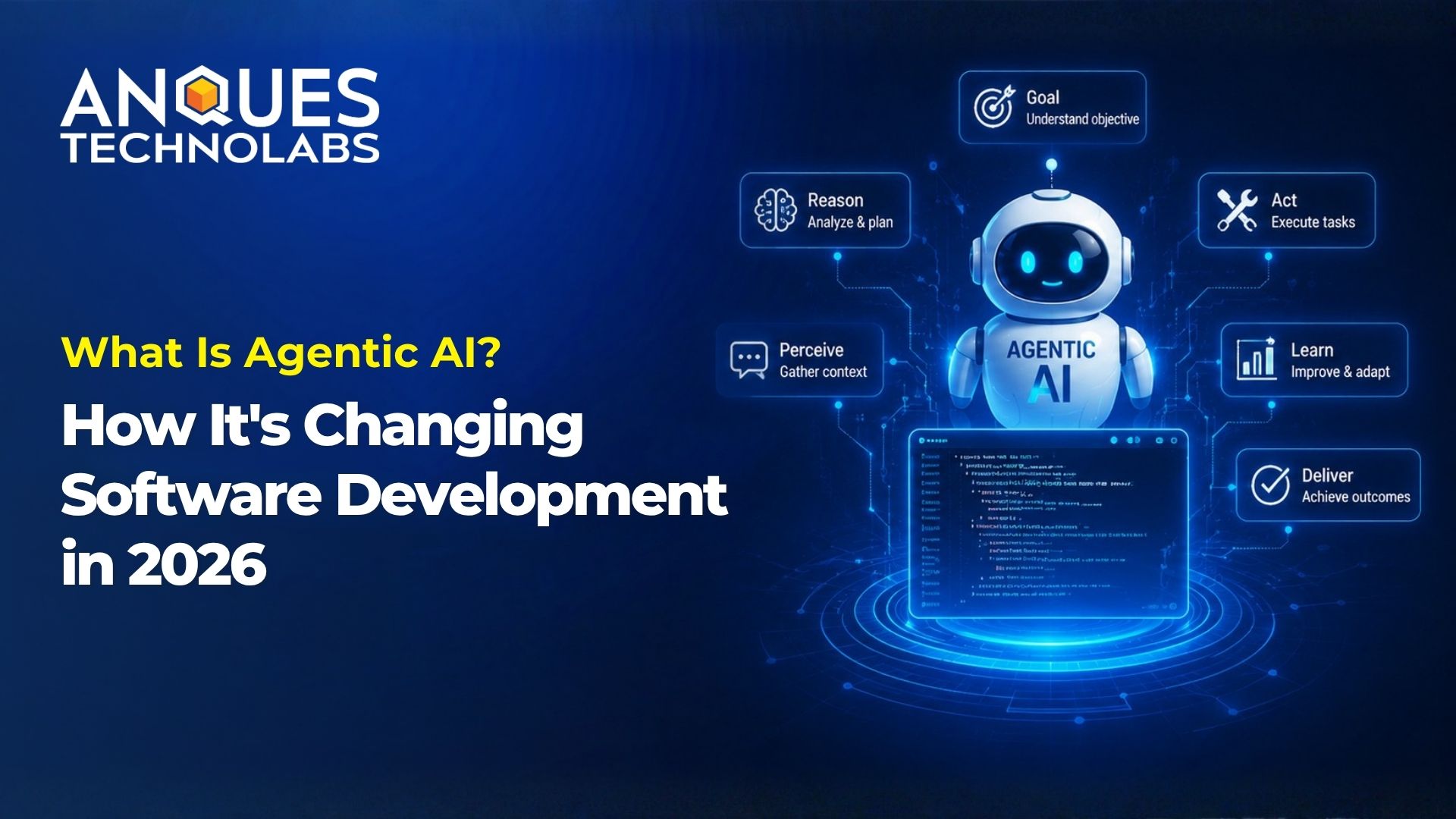
Most agentic AI systems operate on a continuous cycle called the Reason-Act-Observe Loop. Understanding this architecture helps clarify why these systems can handle complexity that would overwhelm simpler AI tools.
Step 1 — Goal Understanding
The agent receives a high-level objective. For example: "Build a user authentication system for our SaaS application."
It analyzes the request, gathers context from the codebase, reads relevant documentation, and identifies the resources it needs.
Step 2 — Planning
The agent breaks the objective into concrete, sequenced sub-tasks — database schema design, API development, frontend components, test coverage, documentation — and determines the most logical order of execution.
Step 3 — Execution
Using available tools, the agent begins working. It writes code, runs terminal commands, calls external APIs, queries documentation, and modifies files — acting on its plan step by step.
Step 4 — Observation
After each action, the agent evaluates the result. Did the tests pass? Did the API return the expected response? Is the output aligned with the original objective?
Step 5 — Adaptation
When something goes wrong — a test fails, an API returns an error, a logic issue is detected — the agent revises its approach, applies a fix, and continues. It does not stop and wait for human intervention; it self-corrects.
Step 6 — Delivery
Once the objective is fully achieved, the agent delivers the final output — functional code, documentation, test results, a pull request, or whatever the task required.
This loop is what makes Agentic AI genuinely different. It is not a smarter autocomplete. It is an autonomous system capable of managing real engineering work from start to finish.
How Agentic AI Is Changing Software Development in 2026
Development teams across the industry are adopting Agentic AI because the impact on productivity, speed, and output quality is measurable and significant.
1. Autonomous Code Development
Modern AI agents can read your entire codebase, understand its architecture and patterns, and implement new features across multiple files simultaneously. They write unit tests alongside production code, flag inconsistencies with existing conventions, and refactor legacy systems to modern standards.
Developers are shifting their focus to architecture and strategic decision-making while agents handle implementation.
2. Automated Bug Detection and Resolution
Agentic AI can run your test suite, identify failing tests, trace the root cause through multiple layers of code, write a fix, verify it resolves the issue, and create a pull request — without any human in the loop until the review stage.
Some teams now have agentic pipelines where entire categories of routine bugs are resolved automatically before a developer even sees the ticket.
3. End-to-End Feature Delivery
Describe a feature in plain language. A properly configured agentic system in 2026 can create the database structure, build the backend API, develop the user interface, configure third-party integrations, write technical documentation, and prepare test scenarios.
Work that previously required coordination across multiple team members is increasingly being handled by a single agent operating end-to-end.
4. Intelligent DevOps Automation
Agentic AI is being embedded in production infrastructure. Agents monitor system performance, detect anomalies, manage deployments, roll back failures, and generate detailed incident reports — in real time, without requiring an on-call engineer to respond.
This allows organizations to maintain higher uptime with lower operational overhead.
5. Continuous Documentation Management
Outdated documentation is one of the most persistent frustrations in software development. Agentic AI systems solve this by watching the codebase for changes and automatically updating API references, technical specifications, user guides, and internal knowledge bases to reflect the current state of the system.
Leading Agentic AI Tools in Software Development (2026)
Claude Code (Anthropic)
A terminal-based agentic coding environment that operates directly within your development workflow. Claude Code reads and edits files, runs commands, and manages complex multi-file tasks with a high degree of autonomy.
GitHub Copilot Workspace
Converts natural language descriptions of features or issues into complete, executable development plans — generating code changes across an entire repository.
Devin (Cognition AI)
Designed as an autonomous AI software engineer capable of handling full engineering tasks from initial planning through final delivery, with minimal human oversight.
Cursor
An AI-native code editor with deep agentic capabilities that understands entire project contexts, enabling agents to work holistically rather than file by file.
AutoGen (Microsoft)
An open-source framework for building collaborative multi-agent systems, where specialized agents work in parallel to solve complex engineering challenges.
Key Benefits for Development Teams
Organizations integrating Agentic AI into their workflows are experiencing concrete, measurable advantages:
- Faster development cycles — Features reach production faster, reducing time-to-market
- Higher code quality — Consistent application of testing standards and best practices
- Improved scalability — Smaller teams accomplish significantly more with the same resources
- Reduced operational costs — Automation of repetitive engineering and DevOps tasks
- Round-the-clock productivity — AI agents work continuously, independent of time zones or business hours
- Stronger knowledge retention — Agents trained on your codebase maintain consistency across projects and teams
Challenges and Risks to Manage
Agentic AI is genuinely powerful, but responsible adoption requires awareness of its limitations.
- Hallucinations and errors: AI agents can generate incorrect code with confidence. Human review of agent output remains essential, particularly for production systems.
- Security vulnerabilities: Agents with broad system permissions can inadvertently introduce security risks or expose sensitive data if not properly sandboxed and restricted.
- Over-reliance on automation: Teams that delegate too much to agents risk losing the deep technical understanding needed when systems fail or edge cases arise.
- Governance and accountability: When an agent introduces a bug into production, clear policies must exist regarding responsibility, review processes, and remediation.
- The recommended approach in 2026: Treat agentic AI as a highly capable but supervised team member. Trust it with execution. Verify its output. Maintain human oversight on architectural and security-critical decisions.
Will Agentic AI Replace Software Developers?
No — and this question, while understandable, misses the more important shift happening.
Agentic AI is not eliminating the need for developers. It is changing what the most valuable developers do. The engineers who will thrive in this environment are those who:
- Design systems and architectures that AI agents can implement reliably
- Configure, direct, and manage AI agents as part of their workflow
- Review, validate, and improve AI-generated code with critical expertise
- Apply deep domain and business logic knowledge that agents cannot replicate
- Think in terms of pipelines and systems, not just individual functions
In 2026, the fastest-growing skill in software engineering is agent orchestration — knowing how to structure goals, configure tools, manage agent memory, and build reliable autonomous workflows. This is a deeply human skill built on a foundation of strong engineering judgment.
The Future of Agentic AI in Software Engineering
The trajectory of agentic AI over the next few years points toward capabilities that seem ambitious today but are already emerging in research and early products:
- Multi-agent collaboration systems — Specialized agents working in parallel on different components of the same project
- Persistent organizational memory — Agents that accumulate deep, long-term understanding of your company's codebase, standards, and history
- Specialized agent marketplaces — Pre-built agents for security auditing, performance optimization, compliance checking, and other specific engineering functions
- Autonomous engineering teams — Collections of coordinated agents capable of owning entire product areas with minimal human involvement
- Seamless human-AI pair programming — Real-time collaboration where the boundary between human and agent contribution is fluid and natural
Agentic AI is not approaching — it has arrived. The question facing development teams today is not whether to engage with it, but how to do so strategically and effectively.
Conclusion
Agentic AI is not a future prediction — it is the present reality reshaping how software gets built, shipped, and scaled in 2026. From autonomous code generation to self-managing DevOps pipelines, these systems are fundamentally changing what development teams can accomplish and how fast they can do it.
But technology alone does not drive transformation. The teams that gain the most from Agentic AI are those that combine the right tools with the right strategic vision.
This is where Anques Technolabs comes in. We help businesses integrate cutting-edge AI technologies — including agentic systems — to build smarter, faster, and more scalable software solutions. Whether you are a startup shipping your first product or an enterprise modernizing legacy infrastructure, our team brings the technical depth to turn Agentic AI from a buzzword into a real competitive advantage.
The shift is already happening. The only question is whether your team is ready to lead it. Ready to get started? Connect with Anques Technolabs and let's build something exceptional together.
Frequently Asked Questions
Q1: What is Agentic AI in simple terms?
Agentic AI is an AI system that can independently plan, execute, and complete multi-step tasks to achieve a defined goal — without needing human direction at every step.
Q2: How is Agentic AI different from Generative AI?
Generative AI produces content in response to prompts. Agentic AI takes autonomous actions — planning, executing, and adapting — to achieve outcomes, not just generate outputs.
Q3: Can Agentic AI write complete software applications?
Modern agentic systems can write code, run tests, fix bugs, update documentation, and manage large portions of the software development lifecycle. Full applications are increasingly within their reach for well-defined projects.
Q4: Is Agentic AI safe to use in production development?
Yes, when implemented with proper security controls, access restrictions, sandboxing, and human review processes. Like any powerful tool, responsible implementation is essential.
Q5: Will Agentic AI replace software developers?
No. It will shift developers toward higher-value work — architecture, strategic decisions, agent orchestration, and validation — rather than eliminating the need for engineering expertise.
Q6: What companies are leading in Agentic AI for development?
Anthropic (Claude Code), GitHub (Copilot Workspace), Cognition AI (Devin), Anysphere (Cursor), and Microsoft (AutoGen) are among the leading platforms in agentic software development tools in 2026.
.png)
.png)